

In a city that moves as fast as Chicago, ambitious women know how to manage deadlines, networks, and career moves. Yet one part of long-term planning is easy to push to “later” your vision. Cataracts and other age-related eye changes are not just medical trivia. They directly affect how confidently you work, travel, lead meetings, read a contract, or navigate a dimly lit restaurant.
This article looks at cataract care through a practical, leadership lens so you can treat your eye health like the strategic asset it is. At the center of that strategy is one key partner, a trusted ophthalmologist.
When you think like a leader, cataract surgery becomes less about fixing a cloudy lens and more about protecting the way you live, work, and show up in every room.
Why Ambitious Women Need A Long Term Vision Strategy
Women often carry double or triple workloads: career, caregiving, and community. That means subtle vision changes are easy to ignore. Blurry night driving, needing more light to read, or feeling exhausted after screen time can look like “just getting older” or “I need stronger readers.”
Epidemiologic data tell a different story. Global analyses estimate that roughly one in six adults has some form of age-related cataract, and the prevalence passes fifty percent in people over sixty. In other words, cataracts are not rare outliers. They are a predictable part of aging biology.
For driven women, this matters because visual decline rarely arrives all at once. It creeps in. You may start avoiding evening networking events because the headlights are too dazzling. You might stop driving to a client site because unfamiliar routes feel risky. Over time, these small adjustments can shrink your world and your options.
A long-term vision strategy means three things. First, you schedule regular comprehensive eye exams with an ophthalmologist, not just quick refractions for new glasses. Second, you track symptoms the same way you would track key metrics in your business. Third, you treat cataract surgery, when the time comes, as a proactive upgrade rather than a last resort.
From Routine Exams To Cataract Surgery: What An Ophthalmologist Really Does For You
An ophthalmologist is a medical doctor who diagnoses and treats eye diseases and performs surgery when needed. For Chicago Arbor Eye Institute surgeon Ema Avdagic, M.D., that scope includes glaucoma, cataracts, and advanced anterior segment surgery, built on training at Columbia University, SUNY, the University of Chicago, and a glaucoma and advanced anterior segment fellowship in Toronto.
In real-life terms, that means your Chicago ophthalmologist can connect the dots between your systemic health and your eyes. Diabetes, hypertension, autoimmune disease, and even long-term steroid use all change cataract risk and timing. A physician-surgeon can integrate your medical story with what they see inside your eye.
For cataracts, that journey usually starts well before the operating room. You may come in because you are swapping glasses prescriptions more often, colors look “muddy,” or oncoming headlights feel harsh. These are classic cataract symptoms as proteins in the natural lens clump and scatter light, producing glare, halos, and reduced contrast.
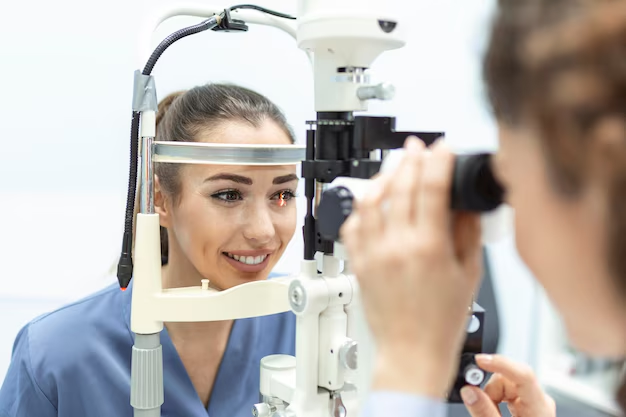
During an exam, your ophthalmologist evaluates not only the lens but also the cornea, retina, optic nerve, and ocular surface. At a technology-forward practice like Chicago Arbor Eye Institute, that evaluation is paired with modern imaging, detailed measurements, and a conversation about your day-to-day visual demands from spreadsheets and slides to Pilates studios and late flights home.
A good ophthalmologist does more than measure your vision; they translate your lifestyle into a medical plan.
How Advanced Cataract Surgery Options Can Protect Your Future Independence
Once cataracts interfere with what you need and love to do, driving, reading, or running a team, it is time to talk about surgery. Cataract surgery is one of the most commonly performed and most successful procedures in medicine, with multiple studies showing significant improvements in quality of life, functional independence, and even reduced risk of falls after surgery.
Mechanically, cataract surgery is elegant and straightforward. The cloudy natural lens is removed and replaced with an intraocular lens, or IOL, a clear artificial implant that does not develop cataracts. At Chicago Arbor Eye Institute, surgeons use both traditional and laser-assisted techniques. Laser cataract surgery employs a femtosecond laser to create precise corneal incisions and fragment the lens, guided by imaging and systems such as the Alcon Cataract Refractive Suite and ORA with VerifEye technology for real-time intraoperative measurements and IOL fine-tuning. This laser approach can reduce ultrasound energy and improve the accuracy of astigmatism correction, with large trials finding comparable safety and refractive outcomes to conventional surgery.
The real strategic decision for you is lens choice. Standard monofocal IOLs are designed to focus at one distance, usually far, which means many people still need reading glasses. Premium IOLs, including trifocal and extended depth of focus designs like Clareon PanOptix, Clareon Vivity, and Symfony, are engineered to extend the range of clear focus and reduce dependence on glasses. Clinical studies of extended depth of focus lenses report good distance and intermediate vision, high satisfaction rates, and favorable contrast sensitivity, particularly for designs in the same class as Symfony and other modern EDOF lenses.
Chicago Arbor Eye Institute has been an early adopter in this space, participating as an FDA investigator for multiple lens technologies and being the first center to implant diffractive multifocal IOLs in Illinois in 2005. That history matters for ambitious patients because experience with premium lenses translates into more nuanced counseling about trade-offs, such as halos versus spectacle independence, and more confidence that your surgeon can match a lens to your visual priorities.
For many women, cataract surgery is no longer just about seeing the eye chart. It is about designing how you want to see your life.
Questions To Ask So Your Eye Care Matches Your Career And Life Goals
Ambitious women are used to asking sharp questions in boardrooms. That same skill set belongs in the exam room. When you meet an ophthalmologist in Chicago to discuss cataracts, consider framing the conversation around outcomes that matter most to you.
You might ask how different IOL options would affect common scenarios in your week, negotiating over video, reviewing fine print on a contract, navigating busy city streets after dark, or reading a bedtime story without reaching for glasses. You can explore how glaucoma risk, dry eye, or a history of eye surgery might change the recommendation.
It is also reasonable to ask about the technology used in your surgery. If a practice uses systems such as LenSx femtosecond laser, ORA intraoperative aberrometry, and image-guided alignment platforms, which can support more precise astigmatism correction and lens positioning, which in turn informs how realistic it is to expect glasses independence. The key is not the buzzwords but the surgeon’s ability to explain how each tool serves your specific case.
Dr. Avdagic’s own philosophy is built around that kind of personalization.
“At Chicago Arbor Eye Institute, our team approaches cataract surgery as a tailored partnership, not a one-time procedure,” says ophthalmic surgeon Ema Avdagic, M.D. “Our goal is to combine advanced technology with patient-centered planning so each person’s vision supports her work, her family, and her long-term independence.”
That framing matters especially for women who are juggling multiple roles. When you see cataract surgery as a partnership, it becomes easier to advocate for what you need rather than accepting a default choice.
Turning Your Next Eye Appointment Into An Act Of Self-Leadership
There is a quiet form of leadership that ambitious women often overlook in their own health decisions. Cataract surgery is a perfect place to practice it.
Self-leadership in this context looks like scheduling a comprehensive exam before vision loss begins to limit your world. It looks like asking whether your cataracts are mild, moderate, or visually significant and what that means for your timeline. It looks like taking the time to understand lens options instead of choosing the simplest path, because you are busy.
From a research standpoint, this investment pays off. Studies consistently show that cataract surgery not only improves visual acuity but also reduces functional dependence, improves mobility, and lowers the risk of falls in older adults, outcomes that directly translate into longer careers and greater autonomy.
Protecting your vision is one of the most leveraged health decisions you can make because clear sight underpins almost every way you create impact in the world.
For women navigating demanding careers in Chicago, partnering with an ophthalmologist who understands both advanced cataract surgery and the realities of modern life can be transformative. It means you are not waiting for vision loss to dictate your choices. You are choosing, early and clearly, how you want to see the next decades of your life.
If you have noticed even small shifts in how clearly you see the city you love, consider this your invitation to treat an eye exam as a strategic meeting with your future self.
