

Choosing among different quantitative PCR machines requires more than comparing sample capacity or asking which instrument runs fastest. Laboratories may have different assay numbers, fluorescence requirements, batch sizes, and workflow arrangements. The right choice therefore depends on how the instrument will actually be used.
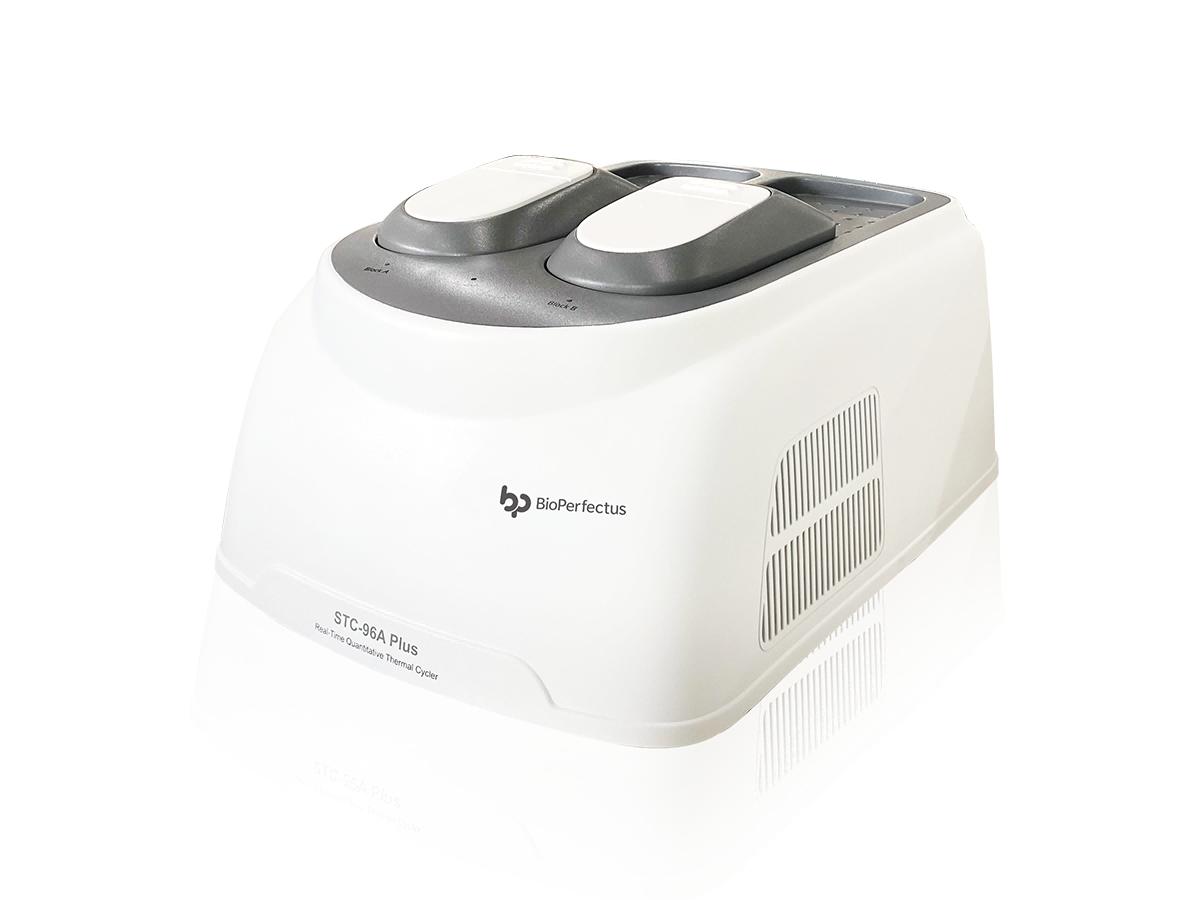
For buyers evaluating a PCR system, the most useful approach is to start with workflow requirements and then connect them to published specifications. The BioPerfectus STC-96A PLUS Real-Time PCR System provides one example of this specification-based evaluation, with dual reaction blocks, multi-channel fluorescence detection, controlled thermal cycling, and 96-well capacity.
Start by Defining How the Machine Will Be Used
A laboratory should first establish whether testing normally involves one assay at a time or multiple assays within the same work period. That distinction can change the importance of block configuration more than headline throughput.
STC-96A PLUS uses two independently controlled 48-well reaction blocks. The manufacturer specifies that the two blocks can run two different assays independently on the same instrument. For laboratories that regularly divide testing between assays, this architecture is directly relevant to equipment selection.
Such a configuration also changes how 96-well capacity is viewed. Instead of treating the plate as a single undivided workload, laboratories can consider whether independent 48-well runs better reflect their routine testing pattern.
Decide Whether One Run or Two Runs Matter More
Capacity becomes meaningful only after the run structure is understood. A laboratory processing one large batch may focus on total wells, whereas another may benefit more from being able to operate two smaller assay groups independently.
The STC-96A PLUS has a stated sample capacity of 96 wells, with reaction volumes from 15 to 100 µL. Supported consumables include 0.2 mL PCR tubes, 8-tube strips, and 96-well plates. These specifications give procurement teams concrete points for matching instrument configuration to existing laboratory practices.
For buyers comparing a quantitative PCR machine, the question is therefore not simply “How many wells does it have?” It is whether the available wells can be organized in a way that reflects the laboratory’s actual assay schedule.
Match Fluorescence Channels to the Assay Design
Optical configuration should be reviewed before selecting an instrument because multiplex or multi-target workflows depend on the available detection channels. STC-96A PLUS lists four standard channels covering FAM/SYBR Green, VIC/HEX/JOE/TET, ROX/Texas Red, and CY5. The product page also specifies excitation and detection ranges for CH1–CH4.
The instrument uses an LED excitation source and a high-sensitivity photoelectric detector. Its optical filter combinations are designed to eliminate crosstalk between FAM, HEX, ROX, and CY5 channels, according to the manufacturer.
Consequently, channel availability should be checked against the fluorophores required by the intended assays rather than evaluated as a standalone feature.
Look Beyond Speed at Thermal Control
Cycling speed is useful, but temperature control directly relates to how thermal protocols are executed. STC-96A PLUS uses Peltier heating and cooling, with a specified maximum ramp rate of 4.0 °C per second and a temperature range of 4–99 °C. The manufacturer also lists tube-control and block-control modes.
Temperature uniformity provides another specification for technical evaluation. The product page states temperature accuracy and uniformity of 0.1 °C. A laboratory comparing instruments can therefore examine ramp rate together with temperature control rather than treating speed as the sole indicator of cycling capability.
This distinction is useful because two instruments can both appear fast on a specification sheet while offering different thermal-control configurations.
Use Capacity and Run Time Together
Run time becomes more informative when considered alongside sample capacity. STC-96A PLUS has a stated run time of less than 50 minutes for its 96-well format. Laboratories can compare that specification with their batch organization and daily testing schedule rather than interpreting speed independently.
The manufacturer also lists sensitivity of 1 copy, reproducibility of CV<0.5%, and a detectable dynamic range of 10⁰–10¹⁰ copies per well. These are published instrument specifications, but assay-specific performance still needs to be established according to the intended testing protocol.
For a PCR system, this makes the evaluation more balanced: capacity, cycle duration, thermal behavior, and stated analytical specifications should be reviewed as a group.
Check Whether the Instrument Fits the Laboratory Setup
Instrument selection does not end with analytical specifications. Physical dimensions, communication interfaces, power requirements, and computer requirements can affect installation planning.
STC-96A PLUS measures 38 cm × 52 cm × 25 cm and weighs 18 kg. Its listed communication interfaces are RS232 and USB, while the specified power supply is 230 V, 50 Hz with 850 VA power consumption.
These details should be checked against the laboratory’s available space and infrastructure before procurement. The manufacturer also lists a Pentium PC with Windows XP, Vista, or Windows 7/8 as the computer requirement, which should be reviewed as part of the installation assessment.
Turn Specifications Into a Practical Selection
A useful equipment review can finish with a short specification-to-workflow checklist: required number of wells, independent assay needs, fluorophores, thermal requirements, expected run frequency, and installation conditions.
STC-96A PLUS illustrates how those questions can be answered from documented specifications. It combines 96-well capacity with independently controlled 48/48 reaction blocks, four listed fluorescence channels, a maximum ramp rate of 4.0 °C/sec, and a stated run time below 50 minutes.
BioPerfectus positions the instrument for gene expression analysis, genetic variation analysis, HRM applications, and research and clinical laboratory qPCR testing. The manufacturer also describes it as capable of standalone operation or integration with broader PCR automation solutions.
The final choice among quantitative PCR machines should therefore begin with the laboratory’s assay structure rather than a generic ranking of instruments. Once workload, detection requirements, thermal specifications, and installation conditions are defined, buyers can determine which documented specifications genuinely matter. BioPerfectus provides STC-96A PLUS as one example where the instrument architecture can be assessed directly against those practical requirements.
